My Religion

For much of my life, I struggled to explain my religious views, not because they were unclear, but because they did not fit cleanly into existing categories. I’m neither traditionally religious nor dismissively secular. I believe something real is happening in religion, but not in the way it is usually described.
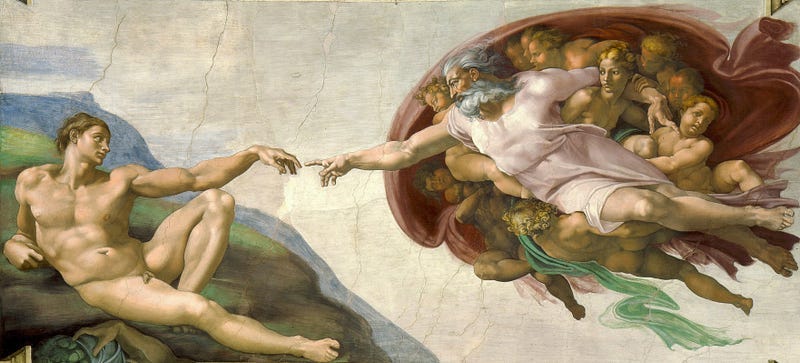
I do not believe God existed before humans in a literal sense. I believe God emerged the moment humans became conscious enough to reflect on meaning, morality, and responsibility. Faced with the vastness of existence and the fragility of human life, we externalized the highest abstractions we could conceive and gave them a name, a story, and a face. That name was God.
This does not make God trivial or false. It makes God human in origin, but universal in function.
I do not treat religious knowledge as categorically different from other kinds of knowledge. I do not place it above mathematics, physics, or philosophy. I place it alongside them. Each domain attempts to describe something real using different methods. Mathematics is validated through internal coherence. Physics is validated through prediction and experiment. Religious knowledge is validated through convergence.
Across cultures and across time, humans independently arrive at similar insights about sacrifice, humility, pride, love, responsibility, and moral failure. When distinct civilizations converge on the same patterns, those patterns deserve serious attention. For me, what makes religious insight “divine” is not supernatural authority, but durability. Ideas that reliably orient human behavior across generations reveal something structurally true about the human condition.
God may be human-made, but that doesn’t make Him disposable.
I view scripture, especially the Bible, as wisdom literature rather than literal history. Its power lies in narrative compression. Stories transmit insight that abstract propositions cannot. They encode moral and psychological truths in characters, conflicts, and consequences. Literalism mistakes the container for the content. Symbolic language persists because it preserves meaning while adapting to changing historical and psychological contexts. I read scripture the same way I read mythology: as stories that preserve hard-won human insight by carrying it through narrative rather than abstraction.
I do not ground my religious views on metaphysical claims; they may be true, or they may not be. God may exist as more than an abstraction or idea, or these stories may gesture beyond human understanding, but religious meaning does not depend on settling these questions. What matters is not metaphysical proof, but orientation. In practice, metaphysical language primarily functions as analogy, expressing truths about how humans should live, relate to one another, and assume responsibility.
Because of this, I believe ritual matters deeply. Prayer, reflection, and keeping God “on the heart” are not about appeasing a deity or affirming belief. They are practices that train attention, ground values, and reinforce responsibility. Ritual reminds us that we are not the center of the universe and that our actions carry weight. Abandoning ritual because one rejects literal belief misunderstands its purpose.
I also reject the idea that any single tradition holds a monopoly on truth. Wherever humans have seriously confronted suffering, love, death, responsibility, and meaning, wisdom has emerged. Different traditions articulate these insights differently, but they often point to the same underlying realities.
This view does not dissolve religion. For me, it rescues it. It allows reverence without superstition, meaning without dogma, and humility without nihilism. It asks more of the individual, not less. If the sacred depends on human participation, then how we live matters more, not less.
Meaning is not handed down from the sky. It is carried, practiced, and renewed, one human life at a time.